Ten puts are not ten separate bets. Not in the month that matters.
You spread your sold puts across ten stocks and feel spread out. In a calm month that is roughly true. When the market falls, stocks tend to fall together, and a book that looked like ten small trades can behave like one large one. Here is a simplified count with the stocks moving separately and with the stocks moving together, then a three-number check to run before your next put.
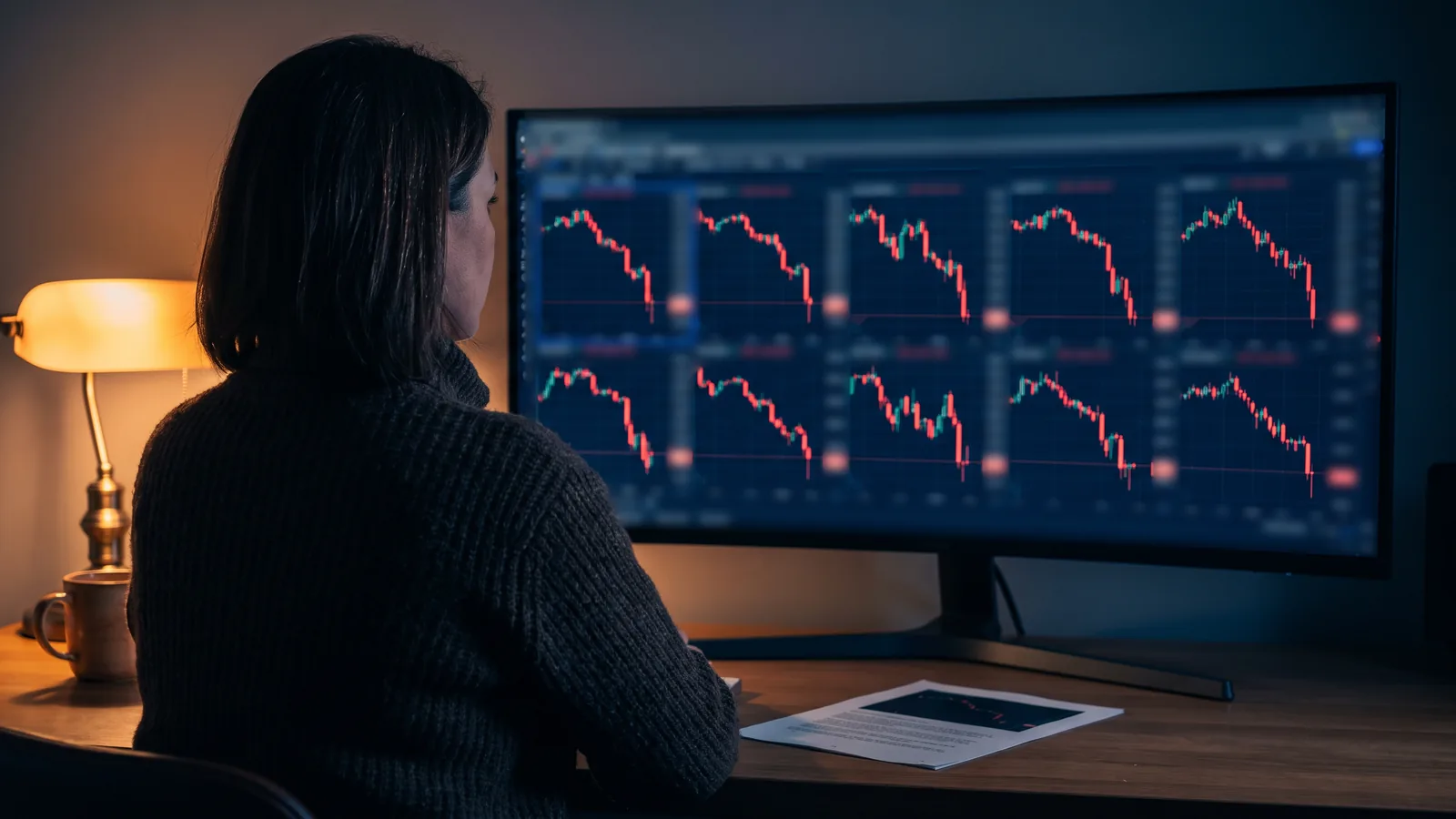
Suppose you hold ten sold puts, one standard contract each (100 shares), on ten different stocks. You sold each one in early December at a delta of about 0.20, and all ten expire on Friday, January 15. Delta is a number your broker shows next to every option; for a put it may appear with a minus sign, as -0.20. In this article it does one job only: it is a rough estimate of the chance that the stock finishes below your strike at expiration. Here, about 1 in 5. Everything below is an illustration, not a real account or real securities.
Ten puts, each with about a 1 in 5 chance of finishing below the strike. What should you expect from that book? Count it. The count has two halves, and the second half is the one that should set the size of your book.
An ordinary month, counted
Start with the simplest assumption: the ten stocks move on their own, with no connection to one another. No real book is quite like that, but it is a gentle case to start from. On average, two of the ten finish below the strike. If you hold a put to expiration and it finishes below the strike, expect to be assigned: you buy 100 shares at the strike. So two assignments is not a bad month for this book. It is the ordinary one.
The average is not the whole story. About one month in three, three or more of the ten finish below the strike. About one month in eight, four or more do. And a stock touches a strike before expiration more often than it finishes below it. A rough working rule puts the chance of a touch at about twice the delta, here about 4 in 10. So expect about four of the ten to be tested on the way, often with a loss showing on the screen, whether or not they recover by expiration.
That is the shape of an ordinary month for ten puts like these. If it surprises you, your book is sized for the hope, not for the arithmetic. And this is the gentle case.
What changes when the stocks move together
That first count assumed the ten stocks move independently. In a falling market, that assumption does not hold up well. Stocks tend to fall together. Research on US stocks has found that they move with the market much more closely in declines, especially sharp ones, than in rises (Ang and Chen, Journal of Financial Economics, 2002).
The options market shows it too. Cboe, the options exchange, publishes an index that uses option prices to estimate how closely the largest stocks in the S&P 500 are expected to move together. The higher the reading, the more closely. In mid-February 2020 it stood at an all-time low of 37.73. Five weeks later, on March 19, 2020, it was just under 85.
So run a what-if. Keep the same ten puts and change one thing only: let the ten stocks move together as closely as that March reading. That is 0.85 on a scale where 1 means exactly in step. Each put keeps its own 1 in 5 chance, so the average does not change: still two below the strike. The shape changes completely. In about 60 months out of 100, no put finishes below the strike at all. The quiet months get quieter. But in about 15 months out of 100, seven or more of the ten finish below the strike, and in about 6, all ten do. With the stocks moving on their own, seven or more happened in fewer than one month in a thousand.
Read that chart for what it is. It changes one thing, how closely the stocks move, and holds everything else still. It is not a count of what happens when the market falls. In a real decline, your stocks also move closer to the strikes of the puts you already hold. So each put's own chance rises as well, and the chart leaves that out. The 85 was one day's reading, taken from option prices, for a basket of large stocks, not for your ten names. And the chances of seven or more finishing below the strike depend on the model named under the chart.
The direction is the part to keep. The more closely your stocks move together, the more of your bad outcomes land in the same month instead of being spread through the year. Spreading a book across different industries still helps, because ten names in one theme can move together long before any bad day. It does not make the stocks independent, and you cannot count on it in a month when the whole market falls.
How many puts, then? Three numbers
The arithmetic does not hand you a number of positions. It tells you which month to size for: the one where much of the book goes wrong together, not the average one. A book sized only for the average month leaves little room for that one. So before you add the next put, work out three numbers, with the new put included.
- The purchase bill. For every put, multiply the strike by 100 shares and by the number of contracts. One put with a 40 dollar strike is a promise to buy 4,000 dollars of stock. Add them all up. The total is what your book has promised to buy.
- The bill against the account. Divide the bill by what would remain in the account if you closed every position and repaid any borrowing today. At 1 or below, the account is at least as large as everything it has promised to buy. Above 1, it has promised to buy more than the whole account.
- The bad-month loss. Assume every stock finishes some distance below its strike in the same month. This example uses 15 percent. Choose your own number, and do not make it a gentle one. The loss is that percentage of the bill, before the premium you collected. Compare it with the account.
Before the trade, write down your limit for the bill compared with the account and your limit for the bad-month loss. Add the new put only if both still hold with it included. If they do not, the trade is a pass, however good the stock looks.
The same ten puts in two accounts
Take the ten puts from the start and give each a 40 dollar strike, to keep the sums simple. The purchase bill is ten times 4,000 dollars, or 40,000 dollars. Now the bad month: all ten stocks finish 15 percent below their strikes, at 34 dollars. The book must pay 40,000 dollars for shares now priced at 34,000. The loss is 6,000 dollars, before premium.
Put that book in a 60,000 dollar account that holds cash and nothing else. The bill is two-thirds of the account, so it could pay for every share and still have cash left. The loss is 10 percent of the account. It hurts, and what to do next is still your decision.
Now put the same ten puts in a 20,000 dollar account. The bill is twice the account. That is only possible in a margin account. There the broker asks you to keep only part of the bill in the account as collateral on the day you sell. That collateral is called the margin requirement, and it is not fixed. It typically grows as a stock falls toward the strike, while the account shrinks by the loss. Here the same 6,000 dollars is 30 percent of the account, and the account could not pay for the shares it promised to buy without borrowing. In a month like that, the decision to close can stop being yours.
Same ten puts, same stocks, same month. The only difference is the size of the promise compared with the account.
With each put's full purchase price reserved in cash, the assignment money is already set aside and that reserve does not grow, even though losses can push the purchase bill above the account's current net value. The third number still applies: in the bad month, the shares you are assigned cost you more than their market price.
A book that passes this check will often be smaller than one sized for the average month. That is the cost, and it is paid in every quiet month, in premium you did not collect. What you get for it is a book that was sized with the bad month in mind before it arrived.
What the check cannot do
It does not stop the losses. In a bad month several puts can finish below the strike together. You either take shares at more than their market price, or buy the puts back, usually at a loss. And it does not promise that the account survives. It shows the loss on these puts in one chosen scenario. It does not include losses elsewhere in the account, and it does not check whether the broker would ask for more collateral. Size is still the part you control before the trade.
It is also built on rough counts, not forecasts. And a stock can open far below its strike after bad news overnight, with no touch to act on. On that morning, unless you put some other defense in place beforehand, the size you chose at entry is the only one you have.
Two lines to write before your next sold put
- With ten puts at a delta of about 0.20, I expect about two below the strike in an ordinary month and about four tested on the way. If that surprises me, I am sized for hope.
- My book has promised to buy ____ dollars of stock. My account is ____ dollars. If every stock finished 15 percent below its strike in the same month, I would be down about ____ dollars before premium. The bill against my account and that loss both stay within the limits I wrote down before the trade. If I cannot write this line, I do not add the put.
Ten puts can pass for ten separate bets in the months that do not matter. In the month that does, they can behave like one. Size for that month.
The free guide
Would You Own It? The Ownership Test Behind Every Put You Sell. Six pages on the question that comes before any premium: whether you would be willing to own the business at all. When you confirm your email, Module 1 of the course, Options 101, opens on your dashboard as well.
About SafePremium Academy
SafePremium Academy teaches a rules-based framework for selling options premium: how candidates are selected, how exposure is sized, and how a position is defended when it moves against you. The method is what survived after years of testing approaches that did not. We trade it ourselves, with real capital today.
Educational content only. Not investment advice. Options involve risk of loss.